
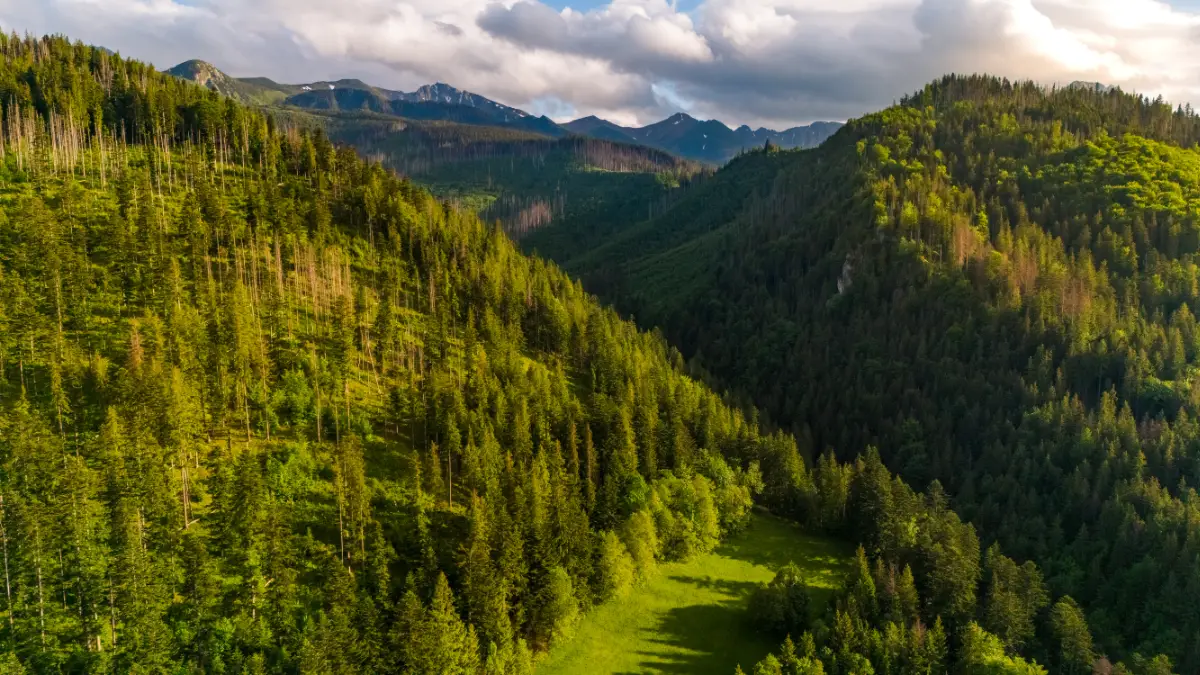
The Kościeliska Valley is a true gem among the Tatra valleys. Beautiful views, easy access, a zero difficulty level, and numerous trails (crossing the valley or starting there) make it — alongside Morskie Oko and Kasprowy Wierch — one of the main destinations on the tourist map for visitors to Zakopane and nearby towns. In autumn, winter, spring, and especially in summer, the Kościeliska Valley attracts countless tourists. They come for the many attractions created both by nature and by people.
Getting there is very easy. The distance from the center of Zakopane is 7 km. If you are driving, follow provincial road no. 958 towards Chochołów. It’s hard to miss the Kościeliska Valley, as there are several large car parks at the entrance. You won’t need to ask, “Where can I park?”…
How to get there without a car? Many minibuses run to the Kościeliska Valley and have their final stop here. After the peak season, when many services are suspended, you can use lines heading to Ciche Górne or Czarny Dunajec.
The Kościeliska Valley was shaped by a glacier and by the Kościeliski Stream, which accompanies you throughout the entire walk. You will cross it several times via wooden bridges. This is also where you can encounter a karst phenomenon typical of the Western Tatras — a spring where water flowing (sometimes for many kilometers) underground emerges back to the surface.
Before your eyes, the landscape of the Kościeliska Valley is changing due to the halny wind. Just three years ago, trees grew on Przednia Kopka. Today you can see how powerful this Podhale foehn wind can be.
The Kościeliska Valley starts at an altitude of 927 m above sea level and is probably the gentlest hiking route in the Tatras. The elevation difference between the entrance and the Ornak Mountain Hut is less than 200 meters. It is also a great place for a trip with a stroller. A walk through the Kościeliska Valley takes about 90 minutes one way on average. You can also travel part of the route by horse-drawn carriage, which goes only as far as Hala Pisana.
After buying an admission ticket, you begin the hike by passing through the Kantak Gate. This distinctive place was dedicated in 1887 to the Polish patriot Kazimierz Kantak shortly after his death. A few hundred meters from the entrance, on the right-hand side, there is a shepherd’s hut in the Kościeliska Valley. You reach the first junction with another trail — the Path Above the Forest Line — and soon after you come to the Robbers’ Chapel. The name is misleading, because the shrine was founded by smelters and miners, whose traces you can find a few dozen meters further on. An impressive karst spring you will encounter is the Ice Spring (Lodowe Źródło). It releases 350 liters of water per second, giving rise to three streams flowing in three different directions!
It is worth leaving the main trail. The Kościeliska Valley is also about caves and grottoes — turning left here you can visit the most popular one. Mroźna Cave is electrically lit to fully reveal its beauty. Please note that it is closed to visitors from November until the end of April. After visiting Mroźna Cave, you return to the main path a few hundred meters further on.
If you do not turn left to the cave, you can hike in the opposite direction along the blue trail to Polana na Stołach, located at the foot of one of the most characteristic peaks of the Tatras — Kominiarski Wierch.
Passing Hala Pisana — where the carriages end their route through the Kościeliska Valley — you can see more caves: Raptawicka, Mylna, and Obłazowa. On the opposite side of the valley, the Kraków Gorge invites you in. Its name comes from the alleged resemblance of the rocks there to the old townhouses near Wawel Castle in Kraków. It is no surprise, then, that a local cave is called the Dragon’s Den.
The Kościeliska Valley is also a place of legends. According to folklore, Janosik and the last outlaws once hid here — and it must be said that the setting was perfect for it.
Just before the mountain hut, which marks the end of the walk through this charming valley, it is worth adding about 30 minutes to visit Smreczyński Pond — a beautifully located lake with a view of the highest peak of the Western Tatras, Bystra.
Smreczyński Pond is, along with Toporowy Niżni, the only place in the Tatras where leeches live — and there are three species. Snails and bivalves also thrive in the mud of these lakes.
It is also worth mentioning the wildlife of the Kościeliska Valley. Due to the large number of tourists, it is hard to encounter bigger animals. Foxes are an exception. The area is home to many species of insects and birds, as well as bats and weasels. Because of dams built on rivers, some fish, such as sea trout, have difficulty returning to their natural spawning grounds.
If you don’t want to return to Kir from the hut and still have plenty of energy, you can head to the Chochołowska Valley or to the Czerwone Wierchy ridge. Returning to the starting point also has one advantage: seeing everything again — and it is definitely worth it!
If you feel like having something to eat, there are several restaurants around the entrance to the Kościeliska Valley.